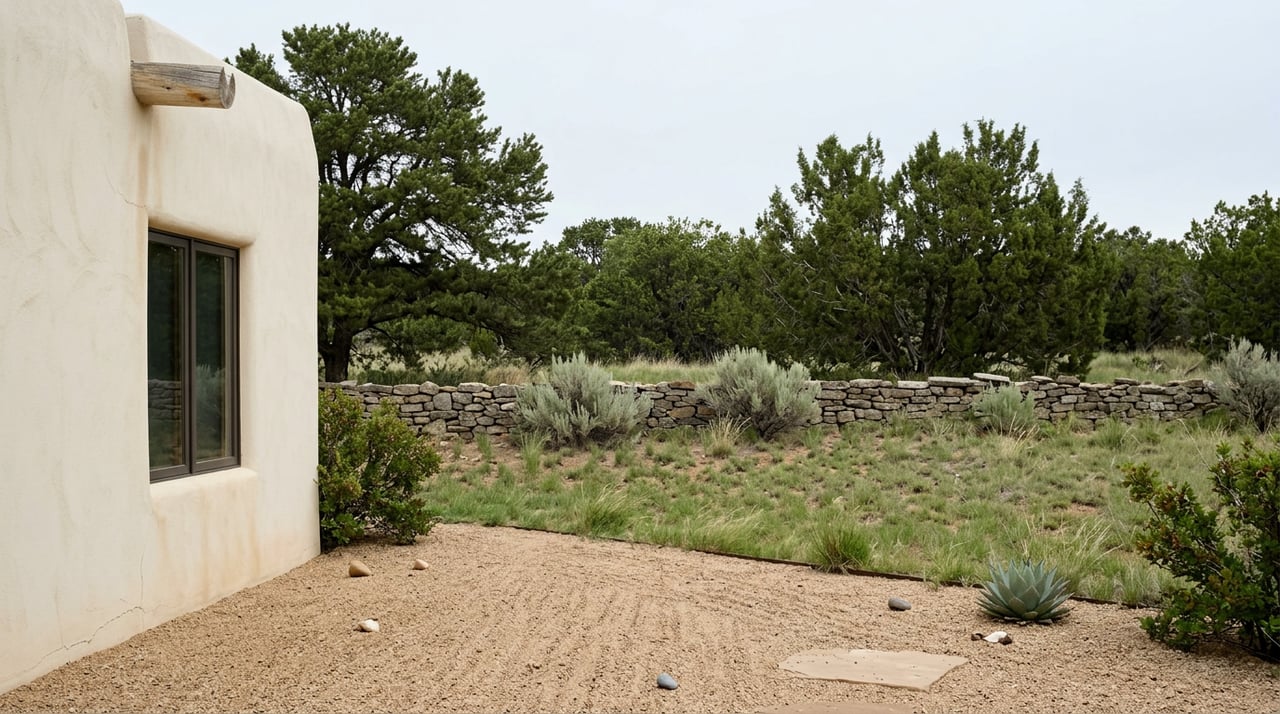


Ride out the north side of the community, past the guard gate and onto the open dirt beyond it, and the ownership changes. The stucco walls and gravel drives that define Las Campanas end at the property line. The trail underneath your tires does not belong to the neighborhood you just left. It belongs, on paper and in practice, to the city of Santa Fe, and for the past year it has been getting rebuilt one Saturday at a time by volunteers who mostly don't live anywhere near here.
The system is called La Tierra Trails. It runs through more than 25 miles of piñon and juniper hills in the city's northwest quadrant, tracing the edge of Las Campanas before opening into rolling open country toward the Jemez foothills. The trails themselves date to the 1990s. Since 2014, the city has contracted their upkeep to a nonprofit, the Santa Fe Conservation Trust, which organizes the volunteer labor that keeps the network passable. None of that maintenance calendar answers to Las Campanas or its homeowners association. It runs on the Trust's schedule and on whoever shows up with hand tools on a given weekend.
A City System That Happens To Sit Next Door
There are two entrances worth knowing if you use the public trails regularly. One is off Camino de los Montoyas, where a hiker gate marks the access point the city built for foot and bike traffic. The other is the Dog Park Connector Trail, built by the Conservation Trust with the City of Santa Fe and GUSTO, the volunteer coalition behind many of the city's connector paths, specifically so people using the Frank Ortiz Dog Park could reach the wider system without driving to a separate trailhead. Follow the trail past the connector toward the Santa Fe Relief Route underpass and it eventually reaches the La Cuchara Trailhead, tucked behind Unity Santa Fe Church, opening into the deeper sections of La Tierra from there.
None of these entrances sit inside anyone's gates. They are public infrastructure, built for the whole city, that happens to run alongside a private community.
The Segment Being Rebuilt By Hand This Year
The distinction matters right now because, as The Santa Fe New Mexican reported, a specific stretch of La Tierra has been under active reconstruction since last fall; if you've walked or ridden it recently, you've likely seen the flagging tape. The Santa Fe Fat Tire Society, a volunteer mountain biking group, identified a 0.3-mile segment with a steep descent into an arroyo as one of the system's most damaged stretches, worn down by monsoon runoff that had turned the trail into something closer to a drainage channel than a path. Rather than patch it, the group is building a new 0.4-mile reroute using grade reversals, small dips engineered into the trail surface to break up water flow before it can carve a channel down the same line again.
Work began in September 2025, on weekends, using hand tools only. No motorized equipment touched the ground. The plan is for the old alignment to be revegetated and obscured once the new segment opens, so foot and tire traffic stops widening the scar while the land recovers. The target was to have the rebuilt section ready by this past spring.
In its report, The Santa Fe New Mexican quoted Carey Harper, treasurer of the Santa Fe Fat Tire Society, on the grade of the new alignment: "Some of the slope should be a little more manageable, but it will still be a climb back out."
The Conservation Trust's trails program manager has pointed to this stretch as one of the most heavily damaged sections identified in the system's past planning work, which is part of why the reroute became a priority project rather than a routine repair.
What This Means If You're Out There This Month
Santa Fe's monsoon season typically runs from July into September, which means this segment is getting its first real test under exactly the conditions it was rebuilt to withstand. If you're on that stretch this month, expect either a finished reroute holding up against summer storms or, if the project ran behind its spring target, the same erosion-prone descent under tape while volunteers finish the work on their own timeline. Either way, the rest of La Tierra's mileage carries qualities that set it apart from the mountain trails above town: mostly sandy, hard-packed footing with only occasional rocky stretches, wide-open sightlines instead of forest cover, and enough exposure that an afternoon monsoon cell is worth checking for before you head out rather than after.
The system carries hikers, mountain bikers, trail runners, and on certain trails, horses, often on the same stretch of dirt at the same time. Blind corners and a full stop for oncoming riders matter more out here than they would on a single-use path closer to town.
Where residents pick up the public trail from this side of the neighborhood:
- Camino de los Montoyas gate, the city-built entrance for foot and bike traffic
- Dog Park Connector Trail, reached from the Frank Ortiz Dog Park, built jointly by the Conservation Trust, the city, and GUSTO
- La Cuchara Trailhead, behind Unity Santa Fe Church, deeper into the network
- Frijoles Trailhead, the entry point used for organized horseback rides on the system
The Private Side, For Contrast
Las Campanas has its own infrastructure that has nothing to do with any of the above. The community's own dog park, a separate amenity inside the gates, hosts a regular gathering residents refer to as Yappy Hour, unrelated to the Frank Ortiz Dog Park across town or the connector trail named after it. The Club's Equestrian Center offers members guided rides across a large stretch of open land tied to club membership, a different piece of ground entirely from the public trail network next door. If your daily experience of the neighborhood only runs through the private side of that line, it's easy to assume the whole picture, the gates, the guards, the groomed courses, extends all the way out to the dirt trail. It doesn't.
Two more things worth watching if you spend time on the public trails. The Conservation Trust is developing an interpretive path along the historic Chili Line railbed near the Buckman Track section of La Tierra, following the route of a narrow-gauge railway that once served northern New Mexico. And the system remains the home course for the annual La Tierra Torture Race, a long-running endurance mountain bike event the Trust has supported for years, worth knowing about even if racing isn't your interest, since it means a weekend of heavier traffic and course markings through the section closest to the neighborhood.
None of this changes how the trail feels underfoot on an ordinary Tuesday morning. But it does mean that the ground just past your gate is shared property in the truest sense, maintained by people who don't live here, on a schedule set by weather and volunteer hours rather than anyone's HOA calendar. Knowing that is part of knowing the place.
For more on what daily life looks like in this part of Santa Fe, from the seasonal rhythms of the neighborhood to the details that only show up once you've lived here a while, Ayden Gramm Real Estate keeps a close eye on Las Campanas beyond what shows up in a listing photo.